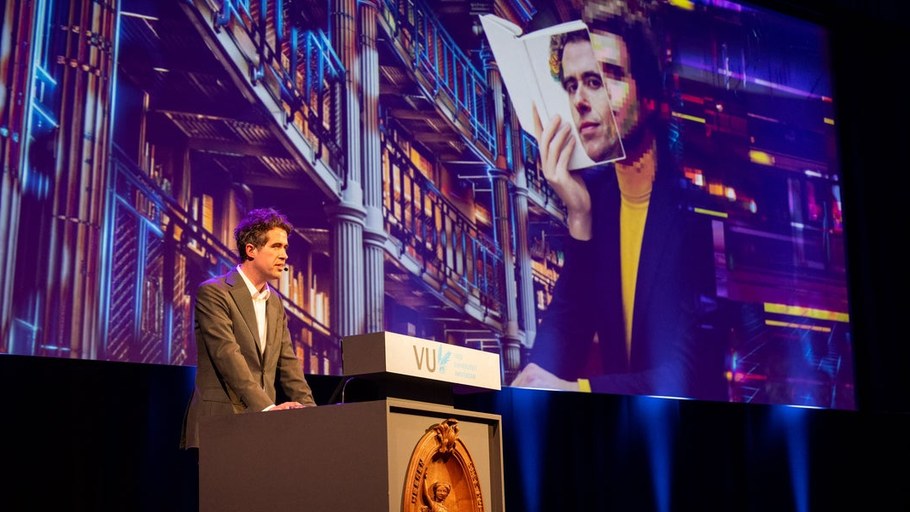
Leo Tolstoy reportedly spent around four years writing Anna Karenina. Artificial intelligence can now produce a novel of similar length in a matter of minutes. That contrast formed the starting point of the Abraham Kuyper Lecture 2026, delivered on 29 May by Writer-in-Residence Thomas Heerma van Voss in the packed Aula of Vrije Universiteit Amsterdam, under the title Menselijke moeite, meaning Human Effort.
Heerma van Voss (born 1990) posed a series of existential questions about what AI means for literature. Why would a writer still write a book if an algorithm produces the same result in minutes? And why would a reader reach for a human author at all? The writer described how he learned his craft through dead-end paragraphs and lifeless sentences, at a time when AI as it exists today was not yet present. He framed that laborious process not as a disadvantage but as a necessity.
During the past academic year, Heerma van Voss was affiliated with VU Amsterdam as Writer-in-Residence. He served as a guest lecturer in the Creative Writing course and organised the essay competition ‘Who writes your words’, in which students were challenged to write about what feels ‘real’ without using AI. The Abraham Kuyper Lecture marked the conclusion of his appointment. His argument was a plea for the unique and the personal, for rough-edged art and searching thoughts, for imperfect stories that can reveal something otherwise intangible.
Following his lecture, two VU researchers responded from their respective fields. Professor of computer science education Felienne Hermans, who does not use a smartphone herself, stressed that every person has their own story to tell. She called that personal story the resistance needed against AI. She proposed assessing students on their effort and learning process rather than their final result, putting it plainly: ‘Give me a bad essay, because then I can help you improve.’ She also noted that universities often push students into the same mould, while the real challenge is helping them discover what makes them unique.
Art historian Klazina Botke addressed the human desire for authenticity in art and literature. She used the example of Rembrandt: people prefer to look at a portrait painted by his hand over an equally accomplished copy by an anonymous pupil from his studio. The origin and process behind a work of art shape how it is experienced. That observation connects closely to the central theme of the evening: the context and human effort behind a work give it a significance that a technically produced output does not automatically carry.