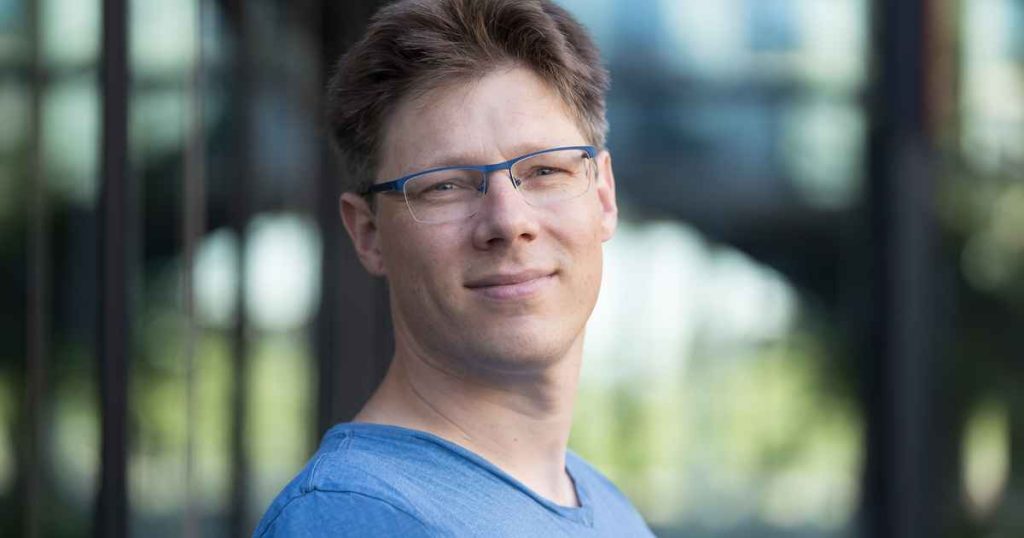
The Navier-Stokes problem is one of the seven so-called Millennium Problems and appears to have received an answer with the help of AI. OpenAI, the company behind ChatGPT, says it has found a counterexample to this question, which mathematicians have been working on for almost two hundred years. For Han Peters, professor of Analysis at the University of Amsterdam, the significance of this development lies not only in the answer to that one problem. Above all, the fact that AI appears able to tackle a problem of this level in such a short time could have major consequences for the way mathematics is practized. We spoke with Peters about the proof, the role of mathematicians, and the question of what happens when computers find answers that people themselves do not yet understand.
What exactly are the seven Millennium Problems?
“Mathematics has countless open problems. Around the turn of the century, seven important questions were selected that people hoped to see solved this century. A prize of one million dollars was attached to each problem. That doesn’t necessarily mean these are the seven most important problems in all of mathematics.”
What is the Navier-Stokes problem?
“The Navier-Stokes problem concerns a mathematical model for fluid flows, for example how water flows. The model also accounts for viscosity: how thick or sticky a fluid is. Starting from a given initial state, where the fluid is located, at what speed it flows and what forces act on it, the question is whether a single, unique solution always exists that remains valid for all time. It’s possible for a system to, in effect, ‘explode’ in finite time. In that case, the solution doesn’t remain valid forever.”
In what way does OpenAI claim to have solved this problem?
“They provided a counterexample. That makes the answer to the original question ‘no’: there are situations in which such a solution doesn’t exist for all time. That doesn’t mean ordinary fluid flows suddenly become problematic. It has only been shown that within this model, and under specially chosen conditions, the solutions don’t exist for all time.”
How do we know whether such a proof is correct?
“The proof was formalised in LEAN. That’s a formal language in which a computer can check, step by step, whether the logical reasoning holds. From what I understand, that check has already been carried out. In that sense, we know the counterexample is correct.”
Is the problem solved, then?
“In a sense, yes, because there is now a formal answer. But the more interesting question is whether this has also made us understand the problem better. Simply knowing that the answer is ‘no’ doesn’t automatically produce new knowledge. Ideally, mathematicians will now try to understand why this solution works and what techniques lie behind it.”
Is AI changing the way mathematics is practised in this way?
“Yes. Normally, you solve a difficult problem by gradually understanding the subject matter better and better. Here, that process is partly reversed: the answer is already there, while human understanding still has to follow. As a field, we’ll have to deal with that. The fact that AI can tackle such a famous problem in such a short time turns the world upside down.”
Is this a turning point?
“Yes, and not just for mathematics. AI has been playing a role for a while, but since this year you can really make a lot of progress with it. Known problems have already been solved with the help of AI before. This is just the first time a famous problem of this level has been tackled in this way.”
Why is mathematics in particular so well suited to AI?
“Mathematics is very precise. A mathematical answer can often be judged objectively as right or wrong. That makes it very well suited to training AI systems. You can have a model give an answer, then check whether that answer is correct, and improve the system based on that. For this reason, AI companies have poured enormous amounts of money into making AI systems good and reliable at solving mathematical problems, in the hope that this leads to AI systems that hallucinate less.”
Does AI play a major role in mathematical research?
“Yes. The number of papers appearing this year is much larger than in previous years, and AI is used in many of them. AI can also help with literature searches, formalising mathematics, and producing texts. That development is moving very fast right now.”
What does this mean for the role of the mathematician?
“That’s still hard to say. In some areas, people simply can’t compete with AI. An AI system can survey much more existing mathematics and also has far more computing power. Perhaps that will make it more important for mathematicians to ask the right questions and to be able to properly understand and evaluate the answers. At the same time, AI is also getting better and better at formulating questions.”
Has AI ‘understood’ something here, or mainly tried a huge number of possibilities?
“Actually, neither. I find ‘understanding’ a difficult word to use for AI, but the system also doesn’t simply search through all possible proofs. It uses huge amounts of existing mathematical knowledge to generate possible answers. AI can then check which parts are correct and retry the parts that don’t work. But in a sense, the proofs currently found by AI are still, to a significant extent, human proofs, because they’re based on existing proofs in literature written by humans.”
Is this a scientific breakthrough or also clever marketing?
“It’s both. It’s a publicity stunt, but at the same time also a scientific breakthrough. For OpenAI, it’s not about the million dollars in prize money. The computing power required alone probably cost far more. But a result like this obviously generates an enormous amount of publicity. At the same time, it remains remarkable that a computer can tackle a problem people have worked on for almost two hundred years.”
Can mathematics become a marketing tool for AI companies this way?
“The first time something like this happens, it obviously makes the news. The second time, it’s already less special. We saw the same thing when computers first beat the best chess and Go players. After that, everyone knew computers could do that. So we’ll have to see how much energy companies like OpenAI keep putting into solving theoretical mathematical problems.”
What is, for you, the biggest risk of this development?
“The biggest risk is that we do get answers, but no longer understand why those answers are correct. If a computer provides a proof that people themselves can’t understand, you might ask what we ultimately learn from that. It’s precisely by wrestling with difficult problems for years that mathematicians develop new methods, which then also prove valuable for other problems.”
Can AI also lead to more understanding?
“Certainly. If AI finds solutions and people then put a lot of energy into understanding those solutions, that could lead to an enormous number of new insights. It could even mean a Golden Age for mathematics. But if people only adopt computers’ answers without understanding them themselves, it could also mean the end of human mathematics. That’s a major challenge for the mathematical community.”
Do you use AI yourself in your work?
“A little bit. I mainly feel I need to know what’s possible with it, partly to properly supervise students and PhD candidates. For literature research, for example, it’s very handy. AI can quickly suggest relevant papers, but those suggestions aren’t always correct. So you still need mathematical expertise to judge what’s right and what isn’t.”
How do you ultimately view this development?
“It’s extremely interesting. It’s talked about every day, including at the UvA and probably at mathematics faculties everywhere. This is genuinely the topic of the moment right now. It’s an exciting time. We’ll have to see what the future brings, but hopefully we, as the mathematical community, will also have influence over that ourselves.”
Interview by Bodiel Siebers