
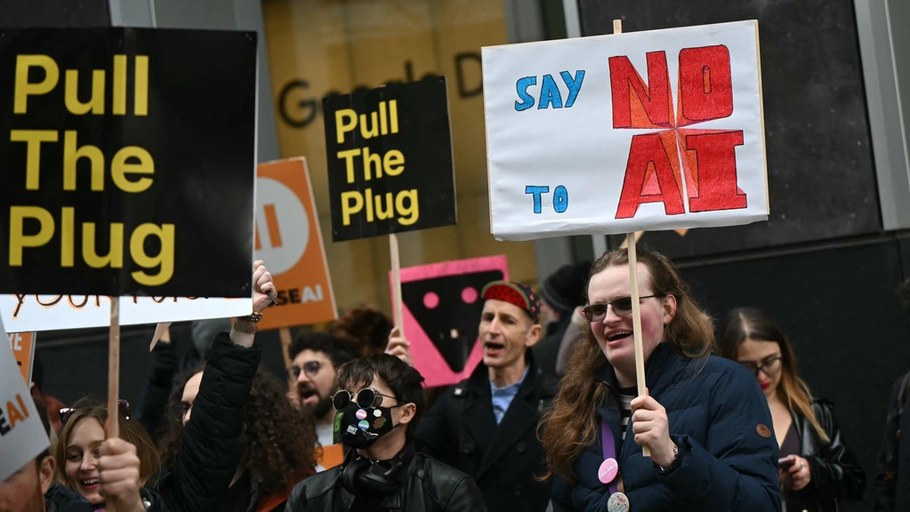
Protests against artificial intelligence are growing across the globe. While some demonstrators focus on AI’s impact on jobs, art, and the climate, others fear a far darker scenario: a superintelligent AI that ultimately eliminates humanity. In the Netherlands, software developer and PauseAI founder Joep Meindertsma is watching developments with serious concern.
Opposition to AI spans a wide spectrum. At one end are the so-called AI doomers, who believe artificial intelligence could eventually bring about the end of human existence. At the other end are more moderate critics, who point to concrete near-term problems such as AI’s influence on education, culture, and the environment. In the United States, anti-AI demonstrations are attracting growing numbers of participants. Not all protests are peaceful: last April, a man threw a Molotov cocktail at the home of Sam Altman, the founder of ChatGPT.
Marietje Schaake, an internet and AI expert affiliated with Stanford University in the United States, observes that a growing number of people are raising questions about the rise of artificial intelligence. She identifies concerns about jobs, the environment, children’s wellbeing, national security, and democracy as concrete examples. According to Schaake, American investment banks are already factoring in the possibility of a large popular movement turning against technology companies. She also expects criticism to increase in the Netherlands, particularly as dependence on American technology becomes ever more visible.
Joep Meindertsma of action group PauseAI says he was jolted into action by the launch of ChatGPT in 2022. As a software developer, he began researching the subject and encountered AI doom thinkers such as Eliezer Yudkowsky and Nick Bostrom, philosophers and ethicists who warn of all-destroying systems that could put an end to humanity. This led him to found PauseAI, an organisation that aims to mobilise politicians and advocates for a global pause in AI development, so that society can reflect on responsible use. Meindertsma is not opposed to AI as such: he considers applications such as medical diagnostics and the treatment of disease to be valuable.
His primary concern is the moment at which AI will itself be capable of developing better AI. That scenario appears closer than many anticipated: Jack Clark, chief executive of American technology company Anthropic, said this week that he expects this could become a reality as early as 2028. Fear of technological progress is nothing new in historical terms. In the nineteenth century, the Luddites sabotaged factory machinery out of fear of the Industrial Revolution, and as far back as 1968 the film classic 2001: A Space Odyssey explored the scenario of a superintelligent computer killing its human crewmates. Scientists continue to urge caution against panic: neuroscientists have pushed back on the claim that AI tools are making people less intelligent, and economists argue that jobs are not about to become obsolete on a large scale any time soon.