
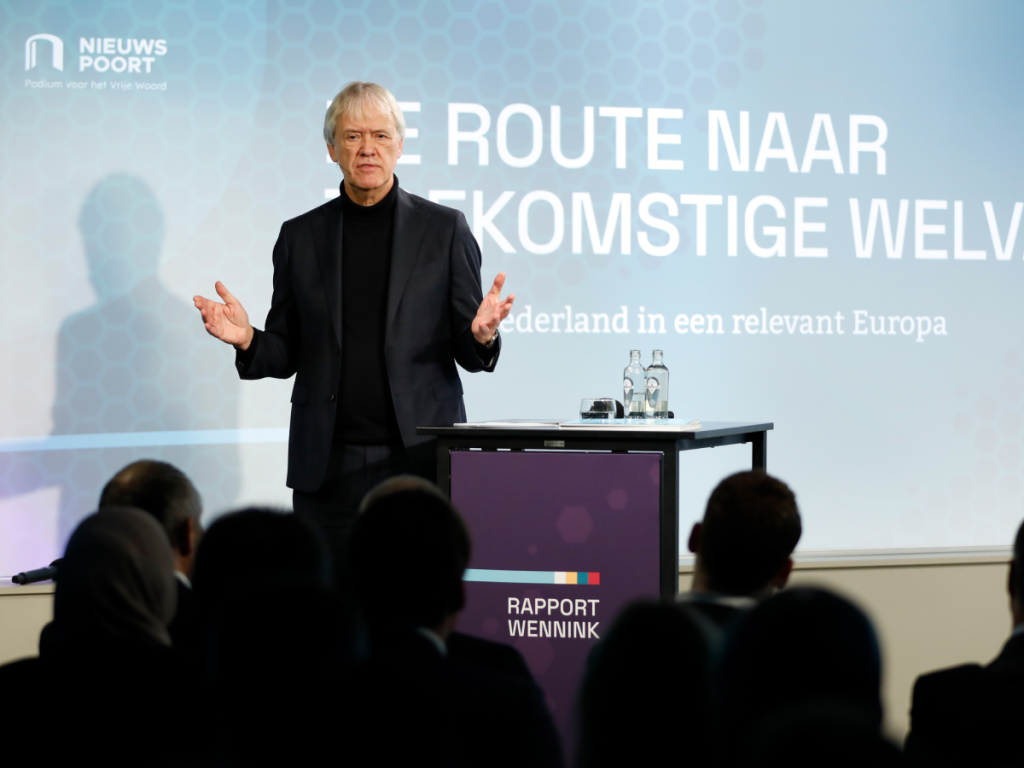
The Wennink Report, The route to future prosperity, presents a concerning picture of the economic position of the Netherlands and Europe. Without intervention, the report warns of structurally low growth, declining productivity and increasing dependence on foreign technology. According to the authors, annual economic growth of at least 1.5 to 2 percent is needed to keep public services, healthcare and security affordable. Current growth projections fall well below this level.
A central conclusion is that future growth will have to come almost entirely from higher labour productivity. Achieving this requires large-scale investment in technology, innovation and knowledge. Digitalisation and AI are explicitly identified as one of four strategic domains in which the Netherlands and Europe can retain their relevance. The report notes that Europe is losing ground to the United States and China, particularly in AI, where investment and scaling happen faster and on a larger scale.
For Amsterdam, this analysis goes to the heart of its role as a knowledge and innovation hub. The city hosts universities, research institutes, startups, scale-ups and societal organisations working at the intersection of AI, data and public values. At the same time, the report shows that technological strength cannot be taken for granted. Without better framework conditions, investment will stall, even in cities with strong ecosystems. Slow permitting procedures, grid congestion, limited room for experimentation and shortages of technical talent are explicitly identified as structural obstacles.
The report also warns that dependence on non-European AI and cloud technologies is not only an economic risk, but also affects privacy, autonomy and democratic control. For Amsterdam, where AI is increasingly used in healthcare, mobility, safety and public services, this underlines the importance of trustworthy, transparent and European technology choices. AI is therefore not a standalone innovation theme, but part of broader questions about governance capacity and societal resilience.
A key action perspective in the report is focus. The Netherlands should not try to do everything, but instead concentrate on technological niches where it can be internationally distinctive. For Amsterdam, this means that collaboration between knowledge institutions, companies and governments is crucial to scale AI applications and translate them into economic and societal value. The report calls for new forms of public–private collaboration, room for experimentation and long-term investment certainty.
The Wennink Report makes clear that inaction is also a choice. Without acceleration in digitalisation and AI, the Netherlands risks losing not only economic strength, but also the ability to achieve societal goals. For Amsterdam, the task is clear: strengthening the AI ecosystem is not a luxury, but a necessary condition for future prosperity, autonomy and public value creation.