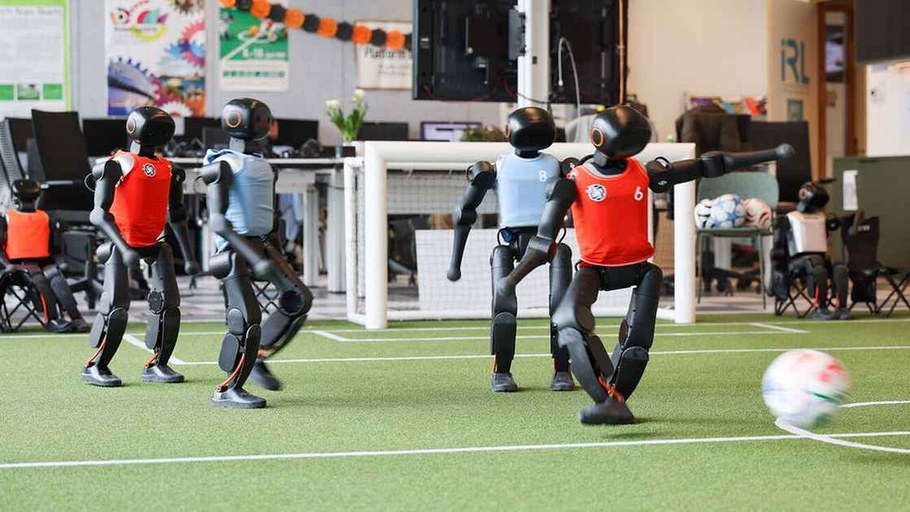
With the Dutch national football team eliminated from the FIFA World Cup, football fans can turn their attention to another team dressed in orange: the student robotics team whIRLwind Amsterdam from the University of Amsterdam (UvA). From 2 to 5 July, the team will compete at RoboCup 2026 in Incheon, South Korea, the world championship for fully autonomous robot football teams.
RoboCup is the international platform where teams of fully autonomous robots, without joysticks or remote controls, play real football matches against one another. The organisation holds an ambitious long-term goal: by the middle of this century, a robot team should be capable of defeating the human world champions. In practice, RoboCup has grown into a large international laboratory for artificial intelligence (AI) and robotics, where students, researchers and companies share software, datasets and insights, openly exchange methods, publish research and test new ideas under competitive pressure.
Team whIRLwind Amsterdam consists of fifteen bachelor’s and master’s students in artificial intelligence and computer science, supported by UvA staff. Half of the team is present in Incheon; the other half provides support from Amsterdam. The team competes in the mid-size class of the Humanoid Soccer League with Booster K1 robots: humanoid machines approximately 95 centimetres tall and around 20 kilograms in weight, equipped with depth cameras for 3D vision, motion sensors and an onboard computer comparable to a powerful laptop. The team faces eighteen other teams from countries including Germany, Ireland, South Korea, Japan, China, Canada and the United States.
Almost all of the robots’ football intelligence is learned rather than hard-coded. The team makes extensive use of reinforcement learning, an AI technique in which software improves through trial and error: good actions are rewarded and poor actions are penalised, similar to how a pet learns behaviour through rewards. In simulations, the robots practise walking, kicking, goalkeeping and locating the ball millions of times before those skills are transferred to the physical robots on the field. Julia de Vries, secretary of Team whIRLwind Amsterdam, explains the team’s approach: the UvA distinguishes itself from technical universities through its strength in theoretical AI, and the team aims to leverage its strong AI models to win matches.
The first match takes place on Thursday 2 July at 04:45 Dutch time (11:45 in Incheon) against the team from Melbourne, Australia. Matches can be followed live via Twitch and YouTube.