There is no drug that cures or slows Parkinson’s disease. Researchers at the UvA are using generative AI to change that.
The number of people with Parkinson’s disease has doubled over the past thirty years to more than ten million worldwide. In this brain disorder, nerve cells that produce dopamine die off, leading to problems with movement and behavior. There are no drugs that cure or slow the disease. Levodopa-based drugs suppress symptoms but cause side effects because levodopa also reaches brain areas where it does not belong.
In a project of the UvA MMD TechHub, postdoc Niki Paspali, associate professor of Molecular Neuroscience Lars van der Heide and assistant professor Ioana Ilie are working on new molecules for treating Parkinson’s. Symptoms only become visible once around 80% of dopamine production is lost, which means some cells are still left. “If you can make those cells work a bit harder, Parkinson’s patients could at least temporarily be free of symptoms,” says Van der Heide. Earlier research showed that activating the receptor Gucy2c increases dopamine production, but the molecule currently used for that is not suitable for patients.
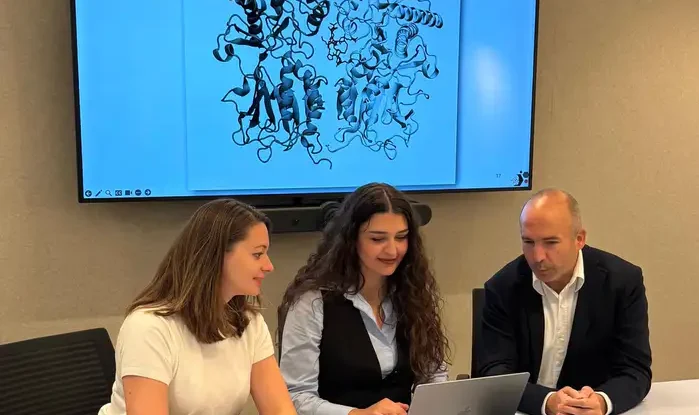
To find suitable molecules, Ilie and Paspali combine rational design based on known structural information with generative AI and molecular dynamics simulations. Candidates are filtered on, among other things, stability and behavior in a biological environment. The best ones are made in the lab, tested and improved step by step. There are also indications that this stops the cells from dying. “If this all turns out to be true, it could become a revolutionary new way to treat Parkinson’s disease.” Because only cells that normally produce dopamine are activated, the side effects of levodopa could potentially be avoided.
The researchers want to continue the collaboration after the MMD funding ends and also apply the approach to other diseases, such as Alzheimer’s or ALS.
Read also