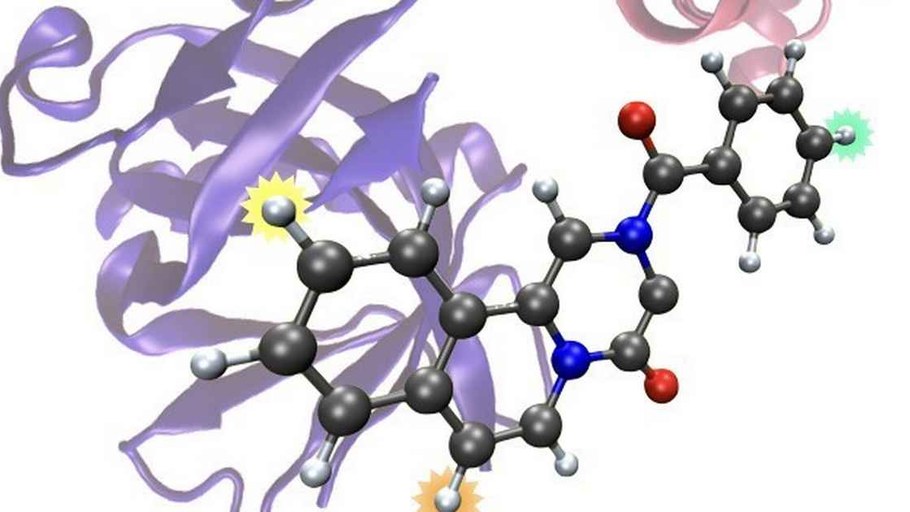
Leaking blood vessels are a serious symptom associated with a range of conditions, including atherosclerosis, chronic rheumatoid arthritis, diabetes, and Covid-19, yet no medication is currently available to treat the underlying cause. A new research project from the UvA MMD TechHub aims to change that by applying machine learning techniques to drug development.
The leakage of blood from vessels is caused by disrupted pressure regulation at endothelial cells, which line the interior of blood vessels. This pressure is controlled by specific proteins called Rho-GTPases, which can take two forms: an activated (“on”) state and a deactivated (“off”) state. In cases of leaking blood vessels, the balance between these two states is disturbed. The research team is therefore focused on finding a molecule capable of switching the protein from the “off” state to the “on” state.
The project brings together Bernd Ensing and Tati Fernández Ibáñez from the Van ‘t Hoff Institute for Molecular Sciences and Jaap van Buul from the Swammerdam Institute for Life Sciences and Amsterdam UMC. The researchers work with a computer simulation of the protein, using it to search for candidate molecules that can trigger the desired conformational change. Promising candidates are subsequently tested in the laboratory at Amsterdam UMC.
To generate candidate molecules, the team uses generative AI. Bernd Ensing, Professor of AI for Chemistry, explains that such a model can be trained on a database of one million drug molecules, after which it learns to recognise patterns and generate millions of new molecules. Starting from an initial molecule, generative AI is used to produce variations. To determine which variants perform better than the original, the researchers apply a machine learning technique called Bayesian optimisation. Improved molecules then serve as the basis for further variations, allowing an optimal candidate molecule to be designed step by step.
Ensing notes that this approach is new: no publications on comparable methods have appeared so far, though he does not rule out that other groups around the world may be working on something similar. The project has been merged with a UvA Synergy project, giving a PhD candidate four years to work on the research. The scientists are also looking to accelerate the path to a viable drug by using already approved medicines as starting molecules, allowing several steps in the conventional drug development process to be skipped. Ensing looks forward to the interdisciplinary collaboration within a team that brings together people with expertise across very different fields.