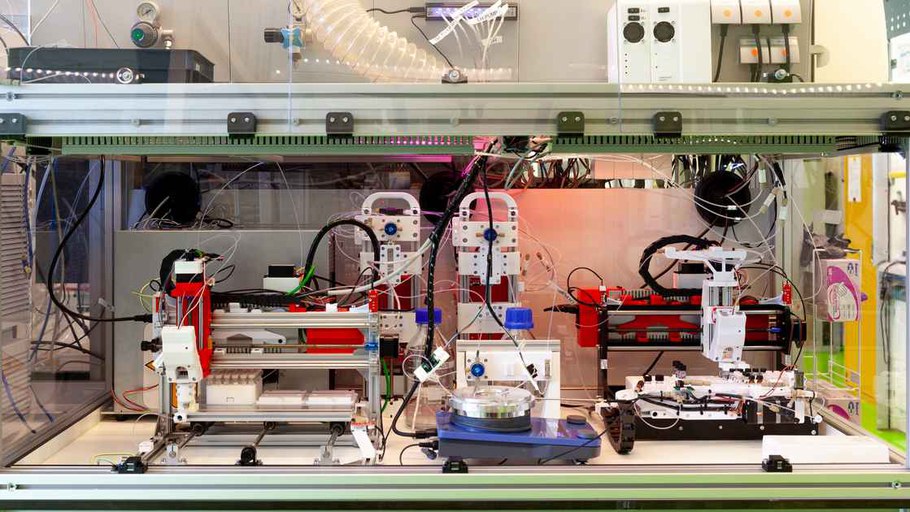
The research group of prof. Timothy Noël at the Van ‘t Hoff Institute for Molecular Sciences (University of Amsterdam) has presented RoboChem Flex in the scientific journal Nature Synthesis. The system is an autonomous, modular laboratory platform for the optimisation of chemical syntheses, with an estimated cost of just 5,000 dollars. The publication includes all the information laboratories worldwide need to build the system themselves.
RoboChem Flex is the accessible successor to the RoboChem concept that Noël’s group introduced in the journal Science in 2024. That original system combined autonomous flow chemistry with an NMR analyser and a machine learning AI module, demonstrating how it could substantially accelerate the development of molecules for pharmaceutical and other applications. The system operates around the clock and can autonomously optimise the synthesis of ten to twenty molecules, a task that would typically take a PhD researcher several months. The drawback of the original system was its price: more than 50,000 dollars, excluding the costly NMR equipment. This prompted the development of RoboChem Flex.
The new version has been designed with affordability and versatility as central principles. It uses commercially available components or 3D-printed alternatives, which significantly reduces costs while enabling rapid adaptation and iterative development. Communication between the hardware components runs via open source software developed by the researchers themselves. According to Noël, this ensures seamless modularity and a plug-and-play architecture that requires only minimal programming effort from the user.
RoboChem Flex incorporates integrated Bayesian optimisation software, allowing users to align the AI-driven optimisation of syntheses with their specific experimental objectives. The system also supports integration with a wide range of existing analytical equipment, further lowering the barrier to adoption. Its application areas span multiple fields, including photocatalysis and biocatalysis. In the Nature Synthesis publication, the research team demonstrates the flexibility of the system through six challenging case studies covering distinct areas of chemistry. All syntheses proposed by the system have been manually carried out in the Amsterdam laboratory to verify practical applicability.
Noël emphasises that broad availability of equipment stimulates scientific progress. The aim of RoboChem Flex is to bring autonomous, advanced synthesis technology within reach of researchers with smaller budgets, thereby expanding their research opportunities, capacity for innovation, and scientific impact.