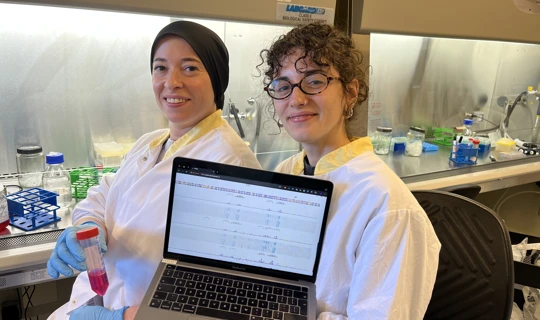
Researchers conclude that gene regulation is much more predictable than previously assumed. In a study published on 4 February 2026, they show how a tight loop between lab experiments and deep learning produced PARM, a lightweight model for reading regulatory DNA instructions.
The study addresses a core biological question: how genes know when to switch on or off. While the classical genetic code explains how DNA encodes proteins, the control logic for many genes has remained unclear. This is highly relevant in cancer research, since many cancer-related mutations are found in non-coding DNA and have been difficult to interpret.
The PARM model was developed through the PERICODE project at Oncode Institute, with NKI playing a key role in both experimental generation and methodological design. Using technology from Bas van Steensel’s group, the team generated millions of controlled measurements on how short DNA sequences affect gene activity. Jeroen de Ridder’s group then used these data to train AI models that capture cell type-specific regulatory rules.
PARM predicts how gene regulation differs across cell types and how it changes under stimuli such as drug exposure. The team also validated model outputs through rigorous follow-up experiments, rather than relying on computational prediction alone. This creates a practical path for interpreting regulatory mutations, with potential value for cancer diagnostics, patient stratification, and future therapies.
The researchers further report that PARM is computationally efficient compared with heavier alternatives, which improves feasibility for academic use at scale. Read more at the Netherlands Cancer Institute website.