
On 20 April 2026, State Secretary Aerdts (Digital Economy and Sovereignty) submitted a proposal for the AI Act Implementation Act for internet consultation. The proposal sets out how the Netherlands intends to organise national supervision of the European AI regulation.
The European AI Act establishes rules for the development and application of AI systems across the entire European Union, with supervision of compliance to be arranged largely at the national level. The proposed Implementation Act creates the legal basis for that supervision. Artificial intelligence is being applied with increasing frequency across sectors ranging from industry and healthcare to digital services, and the cabinet aims to ensure this happens in a safe and responsible manner.
The AI Act uses a risk-based approach, setting requirements for AI systems according to the risk they pose to safety, health, or fundamental rights. Certain applications are prohibited outright, including manipulative AI practices and the mass collection of facial images for biometric databases. High-risk AI systems are subject to additional requirements covering data quality, risk management, human oversight, and transparency. It must also be made clear to users when they are interacting directly with AI systems, for example through chatbots or AI-generated content.
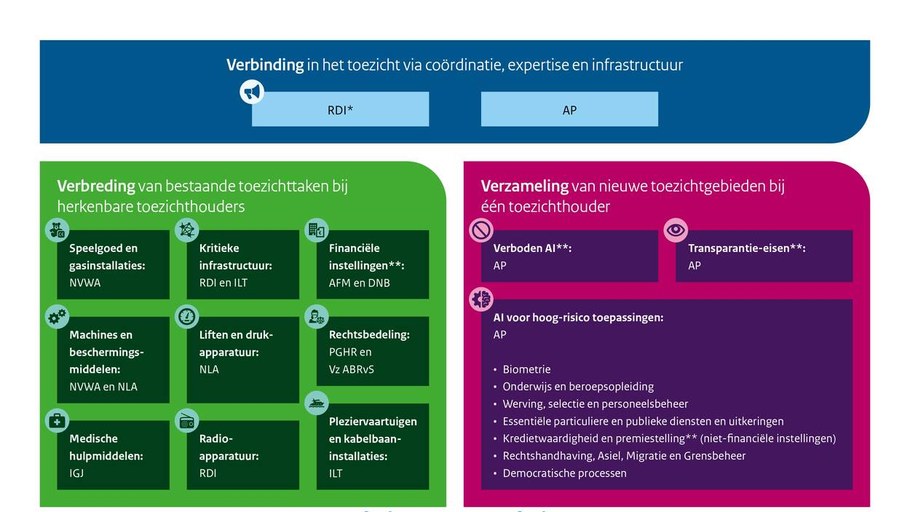
Given that AI is used across many different sectors, the cabinet proposes a collaborative supervisory structure in which multiple existing regulators each oversee AI within their own domain. This approach is intended to ensure that businesses and organisations primarily deal with authorities they are already familiar with. For supervisory areas where no clear regulator currently exists, the Dutch Data Protection Authority (Autoriteit Persoonsgegevens) is proposed as the responsible supervisor, supported by a dedicated AI director. Both the Autoriteit Persoonsgegevens and the Rijksinspectie Digitale Infrastructuur (RDI) are assigned a coordinating role within the proposed supervisory framework.
State Secretary Aerdts has stated that a strong AI supervisory system provides clear rules while preserving room for innovation and entrepreneurship. The legislative proposal is open for public consultation until 1 June 2026, giving interested parties the opportunity to respond to the proposed implementation law.