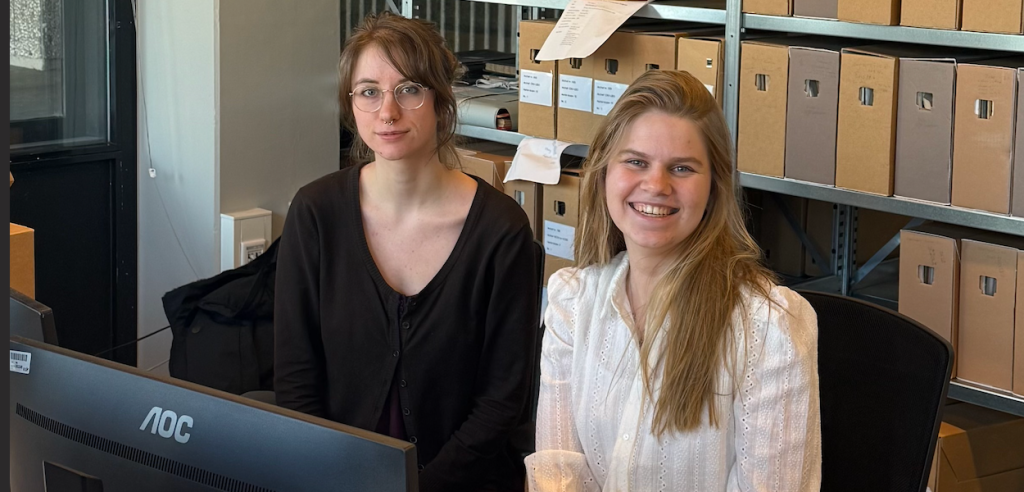
Opening up historical archives often requires painstaking manual work, especially when documents are written in difficult handwriting. At Vrije Universiteit Amsterdam, archivist Myrthe Bleeker and intern Nora Vallenduuk explored how AI can support this process. Their project focuses on the writings of VU founder Abraham Kuyper and shows how artificial intelligence can contribute to the digital accessibility of cultural heritage.
At the Historical Documentation Centre (HDC) of Vrije Universiteit Amsterdam, researchers are working on the digital accessibility of the extensive archive of Abraham Kuyper. According to archivist Myrthe Bleeker, the project is particularly challenging because Kuyper’s handwriting is not only difficult to read, but also changed significantly over time. Together with intern Nora Vallenduuk, she has spent the past years exploring how AI can be used to automatically transcribe these texts.
The project had two main aims: to make Kuyper’s many handwritten documents, mainly correspondence, more accessible to researchers, and to investigate how AI can be used to convert scanned letters into readable digital files. This matters because the HDC manages around one hundred boxes of Kuyper archive material, while another four kilometres of archive material still await digital access.
The team worked with Transkribus, a widely used European AI tool for archival institutions. The model was first trained on manual transcriptions of Kuyper’s documents. Scanned files were then automatically transcribed, after which the results were carefully checked and fed back into the system to further improve its performance.
The team worked with Transkribus, a widely used European AI tool for archival institutions. The model was first trained on manual transcriptions of Kuyper’s documents. Scanned files were then automatically transcribed, after which the results were carefully checked and fed back into the system to further improve its performance.
While AI plays a central role, Bleeker stresses that the process still involves a great deal of detailed manual work. Human verification remains essential, especially when dealing with complex historical sources. The project is now nearing completion, and the team has developed an AI model that can transcribe Kuyper’s handwriting with an error margin of less than ten percent, which is considered a strong result in archival practice.
The value of the project goes beyond the VU archive itself. The model can also be used by other institutions in the Netherlands to make Kuyper-related materials more accessible. In addition, the knowledge gained can be applied to train similar models for other archives, for example correspondence involving administrators and professors connected to VU. The project shows how AI is finding meaningful applications not only in technology and industry, but also in heritage, history and academic research.