What if artificial intelligence no longer relied on electronic chips, but on light? This question lies at the heart of a joint pilot project by the Centrum Wiskunde & Informatica, ARCNL and Photosynthetic. Over a three-month exploratory project, the partners examined the potential and limitations of optical neural networks as an alternative to energy-intensive digital AI systems.
Today’s AI models, such as convolutional neural networks, are powerful tools for tasks like image recognition and medical analysis, but they require substantial computing power and energy. Their performance is also constrained by the clock speed of digital hardware. Optical neural networks take a fundamentally different approach. Instead of software and electronic circuits, they consist of physical optical components, including lenses and phase modulators. Computation occurs as light propagates through the system, in principle at the speed of light and with far lower energy consumption.
Although the concept of optical computing has existed for decades, practical implementation remains challenging. Optical systems are difficult to scale with many processing layers, and key machine-learning techniques such as backpropagation are hard to realise with light. In addition, small physical imperfections can significantly affect performance. These constraints make close collaboration between mathematics, physics and fabrication essential.
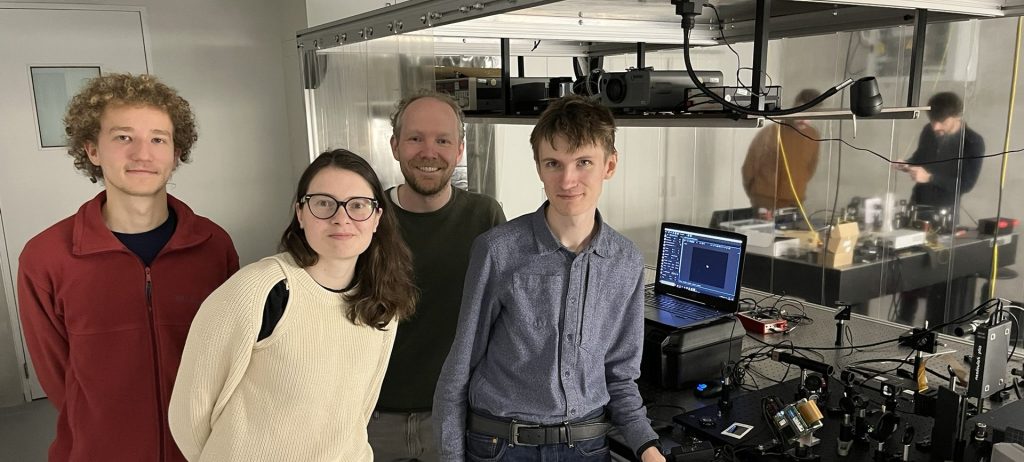
In the pilot project, the researchers combined their expertise to address these challenges. The team first trained a simple, single-layer neural network digitally, tailored to an optical setup. This design was then translated into a physical system using a spatial light modulator. The resulting setup successfully classified numerical digits, demonstrating a proof of principle for functional optical neural networks.
Beyond the technical result, the project offers a glimpse of what may lie ahead. Optical computing blurs the boundaries between hardware and computation, and between physics and computer science. In the long term, such systems could enable data centres to run AI workloads with a fraction of today’s electricity use, and allow smart devices and autonomous systems to make faster, more efficient decisions. At the same time, the researchers stress that realising this vision will require sustained, interdisciplinary research spanning mathematics, computer science, physics and manufacturing.