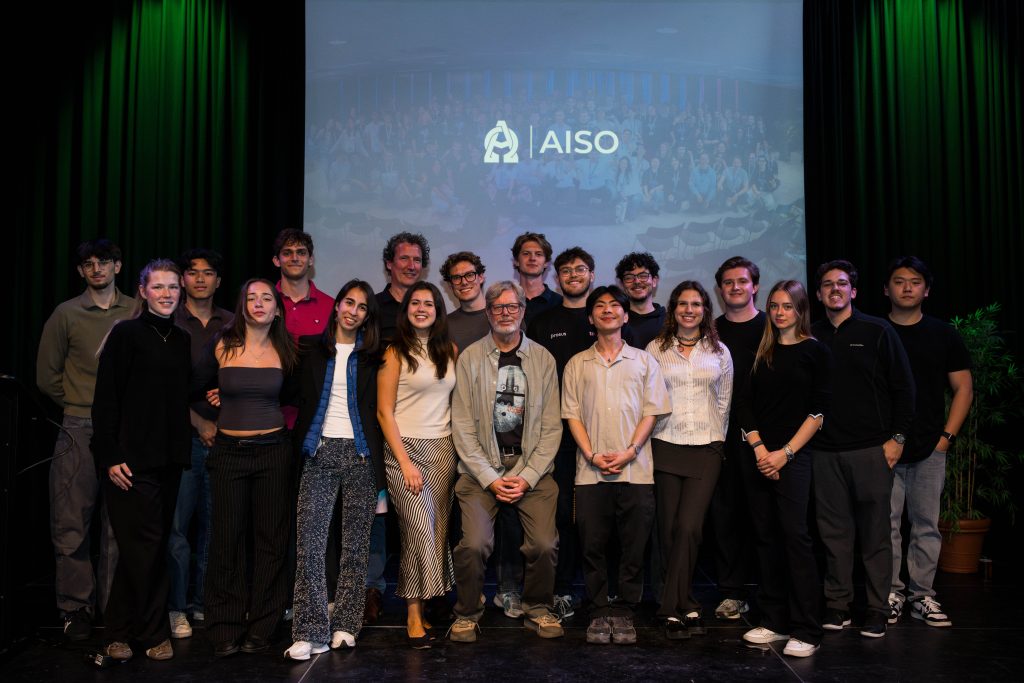
On Tuesday, June 9, AISO, the Artificial Intelligence Student Organisation, organised a fireside chat with Guido van Rossum, the creator of Python, in collaboration with CREA, the Cultural Student Centre. Van Rossum is one of the most influential programmers in the world, so there was a great deal of interest. Students and programmers came together to listen to the story behind a programming language that is used all over the world and plays a central role in artificial intelligence.
The conversation, moderated by Jiaqi Chen, was not only about Python as a programming language, but above all about the ideas behind it: accessibility, collaboration and responsibility. Van Rossum took the audience through his career, his time in Amsterdam and his view of a world in which programming and AI are becoming increasingly important.
From Amsterdam to a global language
Van Rossum has a special connection with Amsterdam. He studied mathematics at the University of Amsterdam and later worked at the Centrum Wiskunde & Informatica, the CWI. At CWI, he was given the space to experiment and work on projects that challenged him. That combination of freedom and curiosity in programming ultimately led to Python.
Python was named after Monty Python’s Flying Circus, a leading British comedy sketch show. He distributed the first version at a time when software was still shared through Usenet groups or on floppy disks. Python’s first release reached the world through twenty small posts. What began as a personal project grew into one of the most widely used programming languages in the world and a foundation of modern open source.
The power of open source and community
During the fireside chat, it became clear that, according to Van Rossum, Python’s success can never be explained by the language alone. At least as important was the community around it. Python was built by people who wanted to learn, contribute and improve. His story shows that technology is never separate from the people who create it.
That idea also returned in his view of AI. Today, Python is a central language for AI developers and is used in countless applications, from machine learning to data analysis and scientific research. Still, Van Rossum spoke in a nuanced way about AI-generated code. He sees AI as a useful tool, but not as something that can replace human knowledge, critical thinking or responsibility. AI can produce code, but that code still needs to be understood, checked and improved by people.
His message to the students was therefore clear: do not only learn how to use tools, but understand what they do. Do not blindly trust systems. Anyone working with AI must continue to think about the quality and reliability of those systems. In a time when AI is becoming increasingly accessible, human understanding is becoming even more important.
Van Rossum also emphasised that programming is more than writing lines of code. It is a way of thinking, collaborating and solving problems. According to him, Python’s strength lies not only in its syntax, but in the culture that has developed around the language: open, pragmatic and accessible. That culture has made Python one of the most important tools for AI.
A message to Amsterdam
His visit to Amsterdam consisted of more than the AISO fireside chat. Van Rossum also spoke at the Amsterdam Deep Tech Showcase and at AI House Amsterdam. At these events, too, the role of community was central. His return to Amsterdam therefore had something symbolic about it. The city where Van Rossum studied and worked, and where Python was able to take shape, now brought together former colleagues, researchers and students.
Van Rossum has since retired. During his visit to Amsterdam, he left behind a clear message: “keep learning and keep building the things you find interesting”. According to Van Rossum, the power and freedom of open source and of a strong community arise from remaining curious.
Report by Bodiel Siebers, Amsterdam AI