
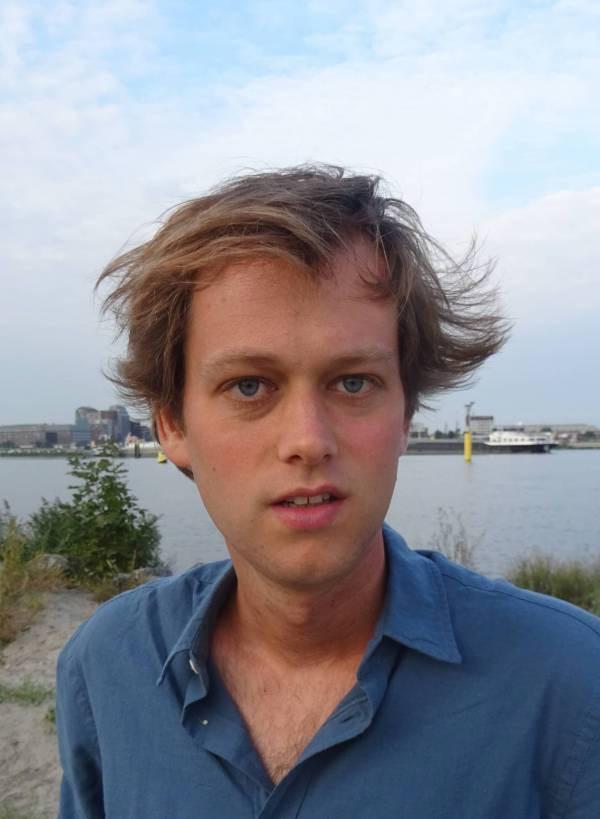
At a time when artificial intelligence is becoming increasingly prominent in science, policy, and everyday life, attention often seems focused mainly on the future: on innovation, scalability, and technological breakthroughs. Philosopher Guido van der Knaap argues that it is precisely the ancient philosophical traditions that are essential to truly understand AI. His book From Aristotle to Algorithm; Philosophy of Artificial Intelligence was named by the Socratesbeker jury as one of the most urgent philosophy books of 2023. Why are these ancient philosophical traditions so urgent when it comes to modern AI technology?
Van der Knaap observes that philosophers and AI researchers are often searching for the same thing: “If you want to replicate intelligence, you are looking for the essence of intelligence. And that is also what philosophers have been thinking about for centuries. What does it mean to be human? What does it mean to be able to think? All those kinds of questions—perhaps beneath the surface—show, I think, a strong similarity between what philosophers and contemporary AI researchers are searching for.”
According to him, this intersection between philosophy and AI is most clearly visible in the domain of cognition: “So what does it mean to be able to think? What is intelligence? These kinds of philosophical questions clearly reappear within AI.” But in addition, a second, equally important overlap emerges: “[…] there is also an overlap between various ethical and political-philosophical questions that arise from the application of AI and how these algorithms are structured. Is there bias or not? Are they discriminatory? These are partly philosophical questions. I may want to create a fair algorithm—people sometimes say, ‘we want a fair algorithm’—but then you first need an idea of what fairness actually is. And that is, in a sense, a deeply philosophical question.”
Dialogue
According to Van der Knaap, the dialogue between philosophers and AI researchers is still often insufficient. This is not due to unwillingness, but mainly to institutional structures: “A researcher has to meet targets, is expected to publish, or has teaching responsibilities.” As a result, academics often have little room to immerse themselves in other disciplines over a longer period of time.
Van der Knaap notes that the relationship between AI and other disciplines often differs per university. Some AI programs are closely connected to philosophy and psychology, while others—such as the University of Amsterdam—are more strongly rooted in computer science. This breadth is precisely what makes AI both difficult and interesting: “It is a very broad subject with a highly technical side and a more human, or perhaps even philosophical, side. And I think it is sometimes difficult for a program or a university to do justice to both. Because if you focus on one, you often do not do the other.”
Cognition
The tension between philosophy and AI becomes clearly visible in the Turing Test. According to this test, a machine is intelligent when a computer exhibits behavior that is indistinguishable from human behavior. Philosophers have raised fundamental criticisms of this idea. Behavior or output, many argue, does not necessarily reveal what is happening “under the hood” of a computer: “So you may display that behavior, but that does not mean you have the same intention, or that you are creative, or that you can think. If I—let’s assume I could—reproduce a painting by Mondrian, that does not suddenly mean I can paint as well as Mondrian. […] The Turing Test claims that imitation is sufficient for the original.”
Turing responded to this criticism by pointing to the danger of solipsism: the philosophical position that one can only be certain of one’s own consciousness. If we demand absolute certainty about a machine’s consciousness, we would have to demand the same certainty about other people: “If we follow that reasoning, then we can never look inside the mind of an AI. But that is an absurd requirement […] I also assume that you have intelligence and that you have consciousness.” According to Turing, we must therefore be pragmatic: “If systems display certain behavior, we should simply assume they are intelligent. You know the argument: if it walks like a duck, quacks like a duck, and has feathers—well, then it is probably a duck.”
Ethics
In addition to cognition, ethics plays a central role in Van der Knaap’s analysis. Utilitarianism is one of the main schools of thought in ethics. It defines ethical action as striving for the greatest possible happiness and the least possible pain for everyone. At first glance, utilitarianism seems particularly well suited to AI: “If AI is good at anything, you would say it is adding, subtracting, and performing calculations. So that leads to a match made in heaven […]”.
Yet Van der Knaap distrusts this apparent obviousness: “But then you encounter all kinds of objections, many of which are philosophical […]. What is pain? What is happiness? How do you measure it? These are all philosophical questions. Then there are also computational questions—can you actually calculate all of this? […] I think ethics is more than just the cold addition of pain and happiness with a calculator.”
He illustrates this with an example from the British philosopher Bernard Williams: “Suppose your wife or girlfriend loves flowers. You know that, so one day you come home and bring her a bouquet. She asks: ‘Why did you bring me these flowers?’ Then you should of course say: ‘Because I love you.’ That is what makes us human and shapes human relationships. But according to utilitarianism, you would have to say: ‘Because this maximizes happiness in the world.’ Well, then she might think: what am I supposed to do with that? So it is not ethical, or not human in my view, to outsource all of this to formulas.”
Another example from utilitarianism is the well-known trolley problem. In this scenario, a trolley is heading toward five people. You are then given the option to divert the trolley so that only one person dies: “You always have to choose between one or multiple human lives. And you can imagine that a self-driving car might find itself in such a situation. Then that car has to choose, because not choosing is also a choice […].” But what if the five people are very elderly and the one person is very young? Or what if one of the five is a murderer? Would diverting the trolley still result in less suffering? These examples show how complex it is to approach moral decisions in a purely utilitarian way.
Van der Knaap offers a response to this problem through Aristotle’s virtue ethics. Instead of focusing on rules or calculations, this approach centers on character formation: developing the right moral qualities and intentions. According to Van der Knaap, this approach is particularly urgent in the age of AI: “I think it is urgent because it provides a kind of counterbalance to those formulas. For me, ethical action is not simply following instructions or applying a formula, as utilitarianism suggests. Ethical action is something you have to develop. It also involves intention—that you act with the right intentions, that the right character underlies it. That is something deeply human, something you have to cultivate. That is why it is so relevant.”
Virtue ethics also appears in recent societal discussions: “You saw, for example, in the childcare benefits scandal, that within government there is now a focus on the ‘human scale.’ You could loosely interpret that as having a virtue-ethical idea behind it.” However, defining this “human scale” is difficult: “What is that human scale exactly? How do we implement it? It is good to keep in mind, but in practice it is not easy to implement.”
Political philosophy
AI also raises fundamental questions in political philosophy. Van der Knaap discusses Karl Marx and his analysis of capitalism as a system of capital concentration and growing inequality. In many ways, AI continues this dynamic: “At its core, AI is a capitalist product. Just look at the companies developing it—a small number of them, and they require enormous amounts of capital.”
This dynamic is also visible in parts of the world where labor is performed for relatively low wages: “[…] those companies often rely on data labeling in, for example, Africa or elsewhere in the Global South, where people, for very low wages—especially compared to the money that companies like OpenAI have—label data or review disturbing content.”
Van der Knaap also refers to philosopher Frank Stilwell, who points to the ironic possibility that automation through AI could lead to a decline in wage labor, potentially bringing capitalism to an end: “Marx’s original idea is that the capitalist profits from the wage laborer and exploits them. That is where capital comes from. So if you reason like that: if there are no more wage laborers, the capitalist has no one left to exploit. In that sense, it makes sense.”
However, according to Van der Knaap, this dynamic has changed significantly: “Capitalism has evolved—it has not stood still over the past two hundred years. It no longer needs wage laborers in the same way to exploit people. It can also rely on capital assets or customers—you can generate profit in other ways. So it is an interesting idea, but it does not seem like the immediate end of capitalism.”
Van der Knaap remains cautious about the future of AI: “There have been many moments when great optimism turned out to be misplaced, or when people were very pessimistic and then a breakthrough still occurred.” The enormous investments made by technology companies in recent years raise a fundamental question: “They are so large that you have to ask: will they really pay off?” Closely related is another question: “To what extent is it actually possible to make a profitable model out of it?” For now, the answers remain uncertain.
From Aristotle to Algorithm
For this reason, Van der Knaap advocates reflection. His book invites readers to take a step back and think about the assumptions underlying AI. As he puts it, it is “more like a summer holiday book”—not because it is easy, but because it creates space for slowing down and deepening understanding. Innovation requires not only a technical approach, but also a human one. Those who develop AI do not just shape systems, but also conceptions of humanity, institutions, and social relations. That is precisely why, according to Van der Knaap, Aristotle remains so close to the algorithm.
Guido van der Knaap is a philosopher, lecturer in Philosophy and AI at the University of Amsterdam, and author of From Aristotle to Algorithm; Philosophy of Artificial Intelligence (2023).
Interviewed by Bodiel Siebers