
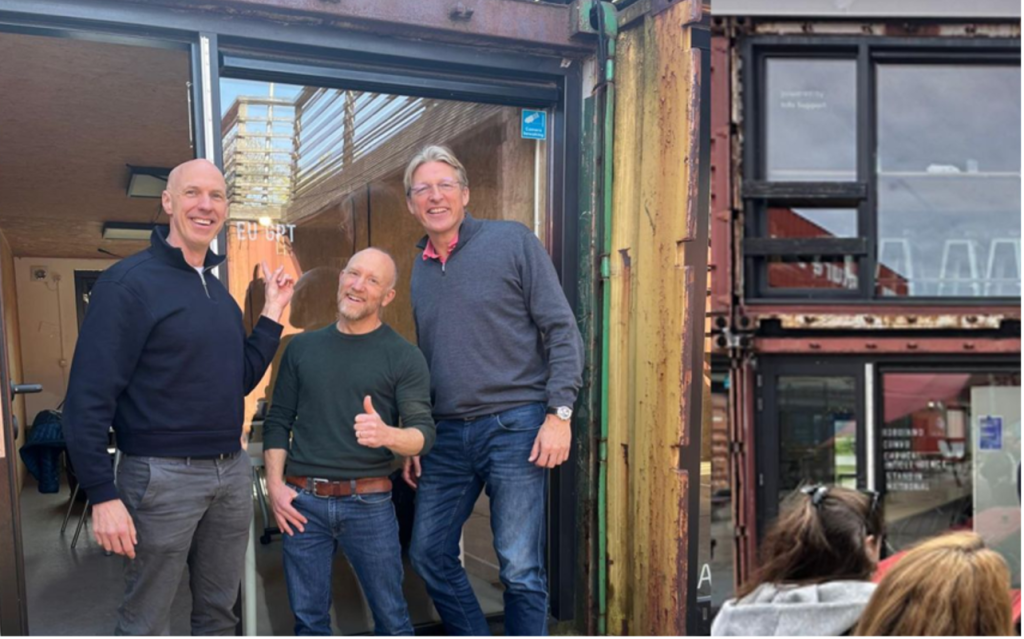
At the AI020 event, EU GPT won the pitch competition. Founder Harmenjan Sijtsma took the stage for the first time alongside his business partner (compagnon) David Leinward to secure the win. “That was actually unexpected,” Sijtsma laughs. “We had never done a pitch on a stage like that before, but it was just really fun to do.” That down-to-earth attitude reflects exactly how EU GPT approaches AI: not as hype, but as a robust way for organizations to use AI safely.
Sijtsma’s background is in econometrics, and his journey started 25 years ago in the financial sector. “Back then, I thought I could conquer the world with models alone,” he reflects. “I immediately got my cover blown. I used to start with: this is a great model, you should use it. But I wasn’t starting from the actual business problem at all. I learned a huge lesson from that. AI may seem easy on the surface, but extracting real value within complex organizations is pure human work. You always have to start with the customer’s requirements.”
What exactly is EU GPT?
“We position ourselves as a sovereign AI assistant, essentially like ChatGPT, but ‘trusted by design’. European values, integrity, and compliance are our absolute starting point, not an afterthought. While many AI solutions try to figure out compliance afterward, we build it directly into our core infrastructure. This is especially critical because of how data is handled. With mainstream systems, you have no idea what happens to your data. Many organizations still run on non-European infrastructure, meaning foreign governments can legally demand access to your data without a proper trial. With EU GPT, your data remains strictly yours.
To guarantee this, we deliberately run our platform on a French cloud provider. This ensures all calculations and data storage remain entirely within Europe under EU legislation. A huge added benefit of this French infrastructure is sustainability: because they plug directly into the French electricity grid, our models run on 95% green and sustainable energy according to EU standards. Sovereignty and sustainability aren’t nice-to-haves anymore; they are the hard foundation of modern data identity.”
How does EU GPT enable AI to automatically think along in compliance?
“Many parties sell AI as mere software, leaving companies to figure out the value and the risks themselves. We fully guide the customer. On our platform, organizations can build custom AI agents in just a few minutes, but we embed the EU AI Act directly into that workflow. The legislation requires risk assessments to prevent AI from making unmonitored high-risk moves, like automatically granting financial credits.”
How does that work in practice?
“We are automating this entire risk assessment process. The moment an agent is built, our platform runs an automated check to determine if it is low, medium, or high risk. A user can only proceed if the risk level is completely acceptable. This makes it incredibly easy for risk and compliance teams to responsibly scale AI, drawing from my previous experience of successfully deploying generative AI for 4,000 highly satisfied users at a major bank.”
Where do you draw the boundary when it comes to AI autonomy?
“Right now, we draw a very strict boundary when it comes to fully autonomous systems, what some call ‘open call’ actions, where an AI independently browses the web to book a restaurant for you. The moment an AI executes external actions like that, you lose control. The machine could easily leak your citizen service number (BSN) or private conversations to the outside world. We don’t do that. We keep the operational scope strictly safe and tightly controlled.
However, looking at the changing geopolitical climate and shifts in US politics, European businesses are realizing they desperately need to become digitally autonomous. That is where our long-term mission comes in.
What can we expect from EU GPT in the coming year?
“The ultimate goal is to bring real value to European organizations. I want to see administrative burdens disappear so that people on the ground can focus on what actually matters: their customers, patients, or citizens. For the coming year, our focus is entirely on scaling up and helping as many organizations as possible extract tangible value from EU GPT. Hopefully, that will generate the revenue we need to continuously reinvest in our product, making it even more powerful and valuable for the European ecosystem.”