
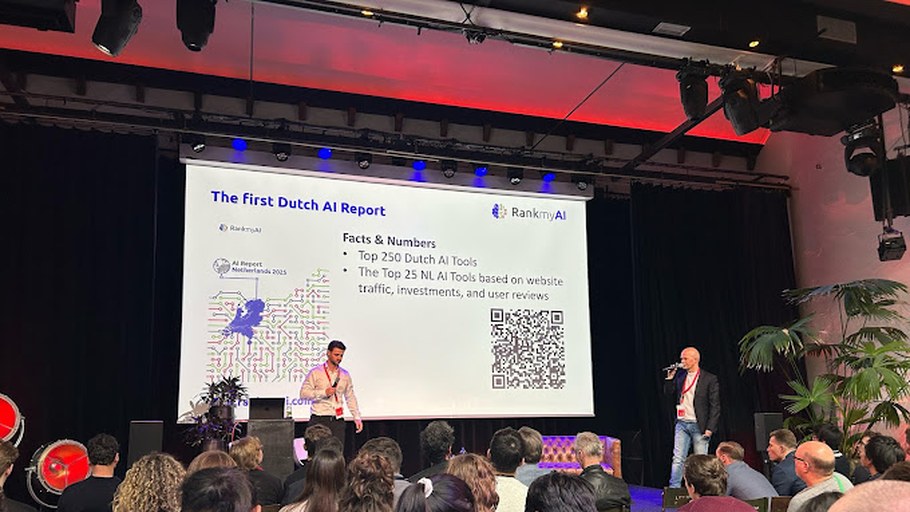
The number of AI companies in the Netherlands is growing fast, but the country remains relatively small and young compared to the rest of Europe. That is according to Het Financieele Dagblad, based on an analysis by RankmyAI, an initiative of the Amsterdam University of Applied Sciences, which mapped the European AI landscape. The research compares the Netherlands with five other European countries based on more than 60,000 AI applications and companies.
The Netherlands now counts almost two thousand AI companies, but that number still lags behind neighbouring countries. Denmark has 2.1 AI companies per 10,000 inhabitants, Norway 1.3, and the Netherlands 1.1. Germany, France and Norway show a more mature ecosystem, with older and larger companies on average, according to the research.
RankmyAI is an initiative of professor Jesse Weltevreden and data scientist David Kakanis, based at the Centre for Market Insights and the Centre of Expertise Applied AI of the Amsterdam University of Applied Sciences. The platform ranks more than 60,000 AI tools and companies worldwide using objective data such as website traffic, investment figures and user reviews, without paid placements. Weltevreden began analysing AI companies in 2022 and presented RankmyAI in November 2024 at the Gala van de Wetenschap.
Two growth waves shape the Dutch AI landscape. The first took place in 2017 and was driven by traditional AI applications such as machine learning and image analysis, with companies including DataSnipper and Amberscript. Since 2023, a second and faster wave has followed, made up of companies applying generative AI to writing assistance, customer contact and legal advice, among other things. Examples include Resleeve, which helps fashion designers create digital clothing collections, and Legal Mind, an Amsterdam company applying generative AI in the legal sector.
The Netherlands stands out mainly in how AI is applied rather than in building AI products. More than a quarter of the Dutch AI ecosystem consists of advisory services and tool development for other organisations, with companies such as DataNorth, WeAreBrain and Deus. The emphasis lies less on developing proprietary AI products and more on implementation within existing businesses.
Studocu, the study platform used by tens of millions of students worldwide, ranks first in the Netherlands according to RankmyAI. Funding remains the weak point of the Dutch ecosystem, according to the research. Compared with countries such as France, where the state investment bank Bpifrance actively funds promising start-ups, the Netherlands lacks a comparable public investor for AI companies.