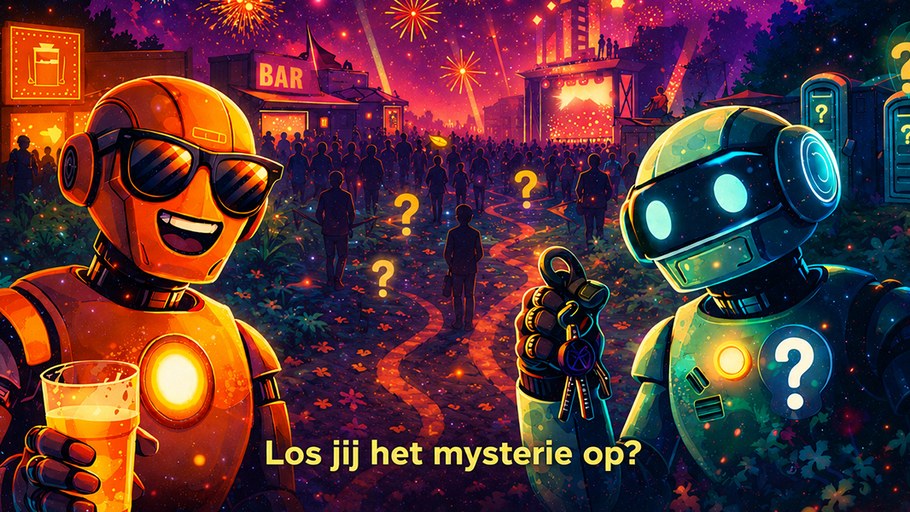
This summer, researchers from Vrije Universiteit Amsterdam are turning the Lowlands music festival into a scientific testing ground for research into social robots. In a specially designed adventure game, visitors search for a mysterious lost code with nine different social robots as their only guides. The project, called ClueBots, is part of the broader research programme ROBOT-BOND.
As festival visitors collect clues and hold conversations with the robots, the scientists study how people experience this technology in a busy, social, and sometimes chaotic environment. The central questions are what makes a robot feel “human” and whether a talking machine is experienced as a helpful assistant or as something uncomfortable and remote.
The research comes at a time when social robots are advancing rapidly. New developments in artificial intelligence are enabling robots to hold increasingly sophisticated conversations and provide support to people. This creates opportunities for sectors facing staff shortages, such as healthcare and education, where robots could keep elderly people company, guide patients, or support pupils in their learning. Before such applications can be deployed widely, the researchers behind ROBOT-BOND argue it is essential to understand how people respond to robots and whether they can form a relationship with them.
A key element of ClueBots concerns what makes a robot feel human. It is often assumed that interaction with a robot becomes more comfortable the more it resembles a person. At the same time, the well-known phenomenon of the “uncanny valley” shows that robots that look just a little too human can provoke an uncomfortable or even unsettling feeling. The researchers suspect, however, that a robot’s appearance matters less than is commonly assumed, and that the sense of humanness lies primarily in the robot’s behaviour: how it speaks, responds, and evokes emotion. Individual differences between people are also likely to play a role, as what one visitor finds pleasant may strike another as strange.
Lowlands offers significant advantages over laboratory studies as a testing environment. Thousands of visitors of varying ages, backgrounds, and experiences come together at the festival, allowing the researchers to study reactions to the robots across a much broader range of people. This produces a more realistic picture of how society as a whole regards social robots.
The data collected will be used within the ROBOT-BOND research project, which examines how and when people can develop an emotional bond with social robots. Alongside scientific insights, the researchers aim with ClueBots to contribute to the public debate and to provide information that shifts perceptions of social robots away from science fiction. The robots used in the project run on locally hosted language models and speech recognition, comply with ethical guidelines, and protect the privacy of participants.