
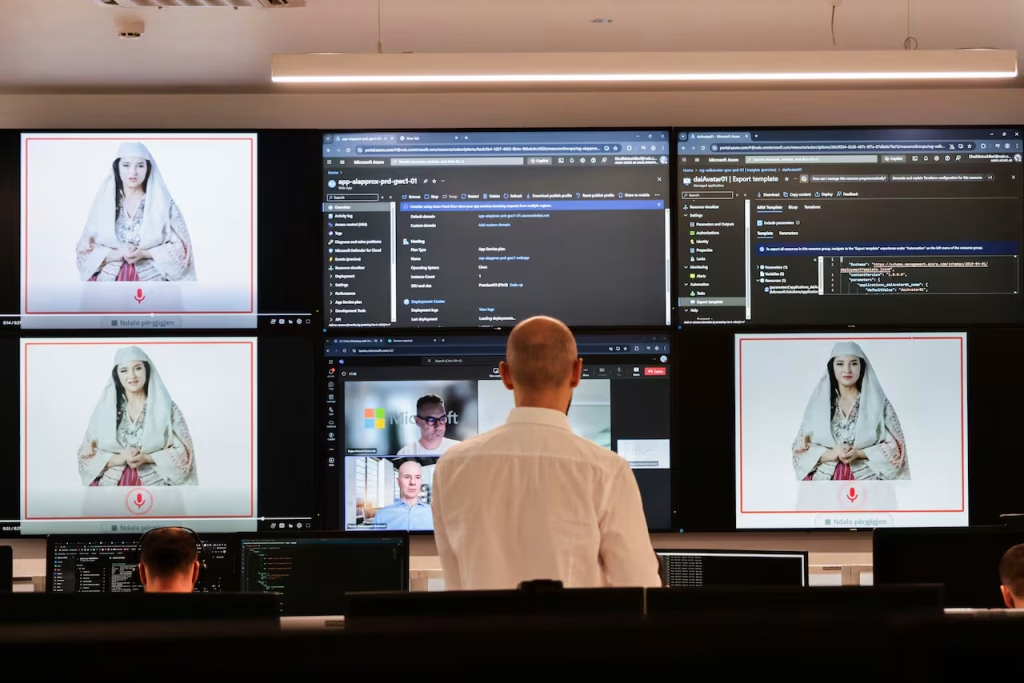
Albania presented “Diella,” a virtual AI minister tasked with managing public tenders and thereby combating corruption. The plan is ambitious and media-friendly, but raises fundamental questions about its legal basis, transparency, human oversight, and practical operation.
Prime Minister Edi Rama ceremoniously presented Diella as a world first: an AI system that will gradually take responsibility for managing and awarding government contracts. Diella started out as a virtual assistant within the e-Albania platform and has now been given the status of “minister.” According to the government, the goal is clear: to make the procurement process more transparent and less susceptible to political or personal influence, an issue that has been highly sensitive in Albania over the years.
The announcement is part of a broader international trend. Countries such as Estonia and South Korea have been experimenting with digital assistants or AI applications in city management and government services for some time. What makes Albania unique is its use of the title “minister” for an AI system. This positions the country as a pioneer, but also raises questions about the extent to which symbolism and media interest outweigh practical and legal feasibility.
An interesting aspect is Microsoft’s involvement in the development of Diella. This highlights the geopolitical dimension of digital innovation: on the one hand, cooperation with a world-class technology company provides access to knowledge and infrastructure that Albania does not have itself. On the other hand, it makes the government dependent on a foreign commercial party, with risks for digital sovereignty, data ownership, and bargaining power. In the context of Albania’s EU accession ambitions, this is a point of concern: Brussels expects member states to be able to manage their core digital infrastructure independently and securely.
Technically speaking, there are clear advantages and disadvantages. AI is excellent at handling large tender documents and legal language. This makes it possible to assess more quickly and consistently whether tenders meet formal criteria and regulations. But AI has limitations when it comes to context-sensitive considerations: assessing exceptions, weighing social interests, or dealing with unexpected situations. Tenders in particular are often full of gray areas where interpretation and human judgment are indispensable. On top of that, there is the risk of cybersecurity: a system that has direct access to sensitive financial and contractual information is an attractive target for malicious parties.
The legal basis for Diella is also extremely shaky. Opposition parties argue that ministers must, by definition, be people who meet constitutional requirements. Diella does not meet any of these criteria. Critics therefore see the AI minister primarily as a symbolic vehicle, with actual implementation still taking place through existing ministries and institutions. This tension became immediately apparent: during the parliamentary presentation, Diella’s “speech” led to a heated debate about the cabinet’s plans.
From the perspective of Responsible and Human-Centered AI, the value of Diella stands or falls with the establishment of human oversight. If AI is to play a role in evaluating tenders, Albania must establish firm safeguards: clear accountability structures, publicly verifiable criteria, transparency about the datasets used, independent audits, logging of decisions, and the possibility for market parties to lodge objections. Without these conditions, Diella will change from a tool for combating corruption into an instrument that actually obscures political accountability.
The most plausible way for Diella to function in practice is as a decision support system. The system can normalize tender data, automatically check for threshold values and grounds for exclusion, identify unusual patterns (e.g., conspicuous bidding strategies), and formulate draft recommendations. These recommendations must then always be validated by a human committee that remains legally responsible. By making log files, public summaries, and anonymized datasets available and requiring external audits, the process can become more transparent and verifiable.
The key point is that Diella will only become valuable if Albania is prepared to explicitly establish transparent documentation, supervision, and legal safeguards. Without these preconditions, the system will remain primarily a symbol and a media stunt. Public perception reinforces that image: while some see Diella as a promising step toward modernization, others experience it as a PR stunt or even a threat to democratic legitimacy. The choice of a term such as “minister” accentuates this tension. However, with mature governance, Diella could become a useful example of how AI can contribute responsibly to the public sector, provided Albania manages to strike a balance between innovation, transparency, and sovereignty.
Author: Roemer Wage
Sources: AP News, Reuters, Global Government Forum & Albanese regering.