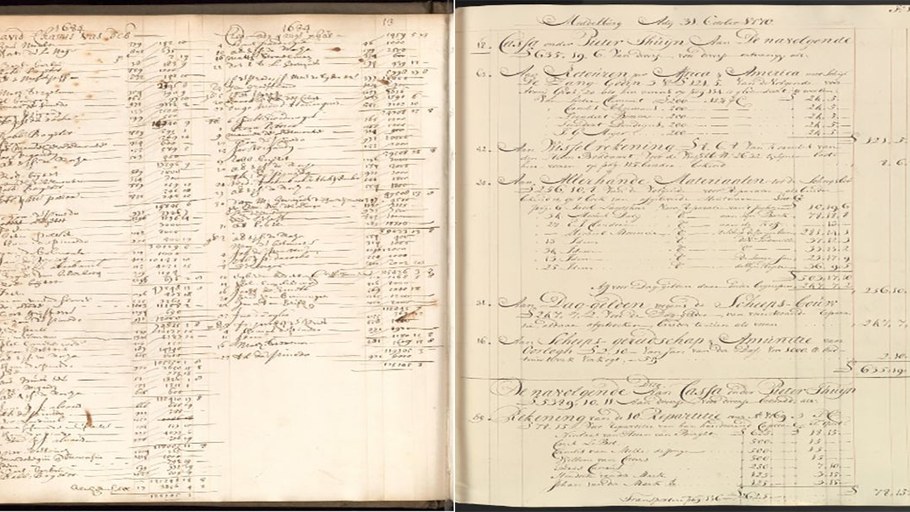
Centuries-old ledgers, trade registers and accounts contain valuable information about commerce, economics and daily life, but their complex layouts and handwriting make them difficult to search or analyse. The FORTES research project, led from Vrije Universiteit Amsterdam, aims to change this using new AI methods.
FORTES stands for Framework for Open Research on Trade and Economic Sources and is led by assistant professor Sabine Go of Vrije Universiteit Amsterdam and the International Institute of Social History. The project has received funding through the TDCC 2025 call of the Dutch Research Council (NWO). Existing AI and transcription software struggles with tables and other complex layouts found in historical documents, meaning that many digitised archival records remain poorly searchable or analysable.
The project will develop open-source methods to automatically convert handwritten historical tables into structured and analysable data. To do so, the team will work with sources including the ledgers of the Amsterdam Wisselbank and the administration of the Middelburg Commerce Company, two collections of major importance to the economic and social history of the Netherlands and its trade networks across Europe and beyond. With the new methods, researchers will be able to analyse historical transactions at scale, reconstruct trade networks and study economic developments over long periods.
The techniques developed within FORTES will also be tested on a range of other sources, such as population registers, patient records, cadastral tables and historical weather data, to ensure broad applicability. Heritage institutions will be able to reuse the methods to make their collections more accessible to researchers, students and the general public. All software, models and datasets will be made openly available.
The project starts in autumn 2026 and runs for 24 months. Alongside technical development, FORTES places strong emphasis on collaboration and knowledge sharing through training sessions, workshops and practical guides for researchers and heritage professionals. The project team includes, alongside Sabine Go, Gerhard de Kok and Lodewijk Petram from the Huygens Institute, Leon van Wissen from the University of Amsterdam, and Christiaan van Bochove from Utrecht University. Collaborating partners include Maastricht University, Radboud University, Universität Regensburg, Erasmus University Rotterdam, the Amsterdam City Archives and the Zeeuws Archief.