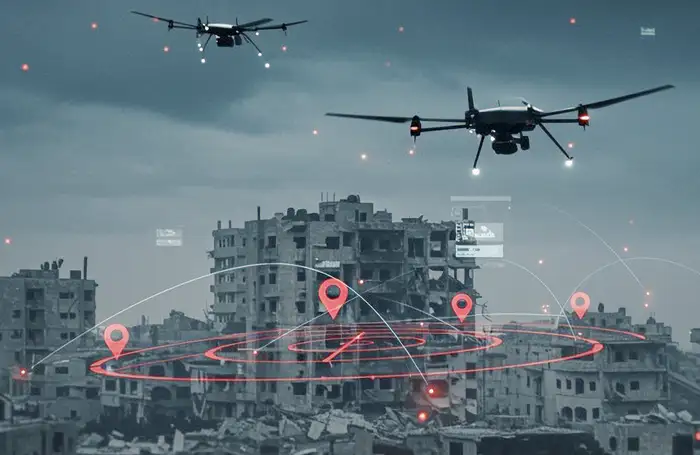
Woodcock found that the selection of targets in armed conflict relies on AI models with significant limitations. One example she highlights is that an AI system may identify a man as a target before a woman, purely as a result of the error margins built into the underlying model. Although such technologies are often presented as solutions to existing problems, Woodcock concludes that AI does not merely introduce errors but reproduces them systematically in ways that are difficult to correct. AI creates the appearance of a logical and neutral decision-making process while in practice amplifying human bias on a large scale.
International humanitarian law (IHL) requires commanders to distinguish between civilians and lawful military targets, to ensure that incidental harm is not excessive, and to take precautionary measures to minimise damage. These requirements remain unchanged, but the way in which decisions are substantiated shifts considerably when AI is involved. Military organisations now process drone footage, open-source information, and human intelligence in volumes that humans cannot handle without AI assistance. The capacity of AI to analyse vast amounts of data rapidly and at scale is one of the primary reasons for its adoption in military contexts.
Woodcock points out, however, that the accuracy rates cited for AI systems only reflect performance in a controlled test environment, not in a chaotic wartime situation. Furthermore, AI operates in a fundamentally different way from the human brain. A striking example from her research concerns an AI classification system tasked with distinguishing between photographs of dogs and wolves. The system performed well, but closer examination revealed that it had based its judgements on the presence of snow in the background, a completely irrelevant feature. In most cases, the reasoning behind an AI system’s conclusions remains opaque because these systems function as a so-called black box, making it exceptionally difficult to legally scrutinise or challenge AI-driven decisions.
When commanders consult legal advisers about decisions that are partly substantiated by AI, this can introduce bias into the decision-making process. Legal categories such as “civilian” and “soldier” may acquire new meanings through the continuous use of AI, with far-reaching consequences for the protection that international humanitarian law is intended to provide. Woodcock concludes that this legal framework may offer protection against harm, but at the same time tolerates a considerable degree of it.